
The Forgotten Secret of Blacksmiths in Ceramic Clay
From Anvil to Pottery Wheel
When people hear the word "waste," they usually think of something useless. But for a potter looking for character and texture, mill scale (the flakes shed at the anvil) is pure gold. Back in my early days at Artkeramika, I was fascinated by how metal could completely alter the nature of clay. At Relyef, we are reviving this approach because we believe the surface of a bowl or sculpture should tell a story of fire and earth.
Watch our reel to see the process.
The Dual Life of Iron in Clay
Mill scale behaves quite unlike other materials because it completely shifts roles during the production process. No other additive acts so contradictorily within the body:
-
The Forming Phase (Temper): Mill scale features sharp edges, unyielding strength during building and drying, and varying particle sizes. When you mix it into fresh or reclaimed clay, it acts much like grog. It strengthens the walls, reduces shrinkage, and helps large slabs hold their shape.
-
The Firing Phase (Flux): This is where the real magic happens. Once the kiln temperature surpasses the melting point of iron in combination with the surrounding silicates, the scale ceases to be a solid particle. It begins to bleed into the surrounding clay body, altering it both structurally and visually.
Visual Effect: Iron Specks and Bleeding
If you look at natural rock faces, you often see rusty streaks and patches caused by weathered iron pyrites. That is exactly what you achieve with mill scale. Unlike fine iron oxide, which stains the entire clay body uniformly, mill scale creates dramatic focal points. It forms a dark center that bleeds smoothly into the lighter surrounding area. You will achieve even more dramatic effects in reduction firings.
Tomáš Macek’s Experience: Beware of Running
"Mill scale is wild and unpredictable. Because it acts as a flux in the kiln, it can literally bleed right through the wall of your piece or fuse it to the kiln shelf at high temperatures above 1200 °C (2192 °F).
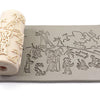
My advice: if you are experimenting with mill scale for the first time, run test tiles and place your work on cookies. I also highly recommend combining mill scale with our Relyef textures. The iron tends to pool and run into the recesses of the pattern, creating deep, almost metallic maps that emphasize the organic, natural expression of the piece." Keep in mind, though, you need to mix in a considerable amount to get this specific effect.
How to Work with Mill Scale
-
Step 1: Sourcing the Material Stop by your local blacksmith. They will usually let you have it for a beer or a small fee. Personally, I used to buy it from the rolling mills at the Vítkovice steelworks. If you cannot find iron mill scale, you can try other metal filings. Copper filings, for instance, yield fantastic results.
-
Step 2: Dosage Start small - around 3% to 5% of the dry clay weight.
-
Step 3: Mixing It is easiest to incorporate the scale into a semi-liquid slip during reclaiming, but you can also wedge it directly into prepared clay.
Tip: Always test a new batch of mill scale on a small test tile before applying it to your main work. Different forge sources contain varying amounts of unoxidized iron core, which drastically alters the melting point and how much the iron will run.


To learn more about how internal structure prevents warping in large pieces, check out our guide on Grog and Fireclay: The Skeleton of Your Clay Body.
In Conclusion
Using mill scale is a path for those who do not fear experimentation and want to break away from the uniformity of commercial clay bodies. It is a dialogue between metal and clay, finalized by the fire inside the kiln.
-
Posted in
ceramics, clay, mill scale



Rovnoměrnější rozložení efektů se mi dařilo s pilinama. Měděné a bronzové pěkně reagují v redukčním prostředí keramické pece.