The Wooden Heart of a Slab Roller - Why We Roll Clay Canvas-Free
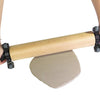
The wooden roller on the Relyef SVS tabletop Manual Slab Roller lets you process ceramic clay directly, no canvas or Slabmat required. Wood leaves zero fabric weave or grid impressions, giving you an instantly smooth surface ready for stamping and texturing. To keep the wood naturally non-stick, treat it with linseed oil once a year and raw beeswax roughly once a month under heavy studio use.

You know the drill. You roll out a beautiful slab, lift it carefully and there it is: a canvas texture embedded in the clay. A fine checkerboard grid sitting right where you planned to press a crisp stamp, ruining your detail. So you try a Slabmat. Then a second piece of canvas. Then cornstarch. Suddenly, you have more gear on your table than clay.
We went through this scene at Relyef so many times that when we designed the SVS Manual Slab Roller, we asked a simple question: What if the clay did not need to rest on anything?
Wood was the answer.
In our comparative guide on wooden versus stainless steel rollers, we broke down when to use each material. This guide goes further: I will show you how to work with a wooden roller in the studio, how to care for it so it lasts for years, and how to roll a perfectly clean slab with zero canvas.


Why We Chose Wood for the SVS
Metal is easy for manufacturers. You buy it, machine it, and ignore studio humidity or temperature. Caring for wood takes extra work, which is precisely why most machines skip it.
We made this choice in the workshop, not at a desk. Tomáš brings over 35 years of ceramics experience, while Radovan brought the structural engineering behind hundreds of our tools. The story of our slab roller and patent comes down to building what we needed ourselves. For the roller, we tested multiple wood species and surface finishes, searching for one balance: dimensional stability versus natural release from wet clay.
Dense hardwood, properly and slowly dried, does not soak up water or suction to wet clay. Metal is non-porous and ultra-smooth, which causes wet clay to stick. Wood features a microscopic pore structure that breaks that surface tension.
There is another element you won't find in a brochure: tactile feedback. A wooden roller tells you how much compression you are applying. You feel when the slab is done before you look at it.
From the Relyef Workshop
Tomáš notes: "I tested wood on rollers for several years. We tried different species and finishes, but we kept coming back to one truth - properly dried wood treated with raw linseed oil performs reliably in daily production. After a few years of shop use, it looks even better than the day it was made."
Věra adds: "I see it immediately in my workshops. Beginners using a wooden roller stop overthinking their technique and start creating. That is the goal: a tool that gets out of your way."
Canvas-Free Rolling: Step-by-Step
This is workshop know-how passed down at the workbench - five steps to a clean slab without interlayers.
-
Prepare your work surface. Roll directly on a clean particle board, paper board, or Slabmat plaster, plywood, or tempered hardboard also work. A bone-dry board sucks moisture out too fast and causes sticking; a soaked board turns clay to mush. Aim for a board that feels cool to the touch, not wet. Canvas or carpet works too if you don't mind texture on the underside.
-
Knead your clay thoroughly to the right stiffness. Freshly wedged clay right out of the bag is often too soft for canvas-free rolling. Let it air out briefly on your board. If a slab holds its shape when lifted by one corner, it sits at the right consistency.
-
Step down your thickness gradually. The most common error is setting your final target thickness immediately. This compresses clay unevenly, causing tears and stress. Clay remembers strain; it will warp or crack during drying or firing. Pass the slab through two to three times, rotating it 90° between passes. This aligns the clay particles so the slab stays flat in the kiln.
-
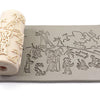
Compress the surface with a metal rib. This step separates a decent slab from a stamp-ready surface. A few light passes with a flexible steel rib seal the surface pores and unify the microstructure, creating a base where pattern rollers and stamps print maximum detail. Without compression, impressions bleed - one of the most common stamping mistakes.
-
Release the slab by rolling, not pulling. Without canvas, you have nothing to yank. Lift one corner using a thin metal spatula, then ease under the entire edge. Roll the slab back smoothly instead of pulling up. If it adheres firmly, slice underneath with a cutoff wire just like removing a piece from the wheel. Save your trimmings for reclaim.
Caring for Your Wooden Roller: Linseed Oil & Beeswax
Wood does not stay non-stick on its own, but maintaining it takes less time than cleaning up after a workshop class.
Raw Linseed Oil - The Foundation (Once a Year)
Pure raw linseed oil (not boiled linseed oil with synthetic dryers) deeply penetrates the wood grain. It protects against micro-cracking in heated studios and keeps the roller from pulling excess water out of your clay.
Process: Ensure the roller is bone-dry. Apply a thin coat over the entire length using a rag, let it soak for 20 minutes, and thoroughly wipe off any excess. Allow it to cure for 24 hours. A greasy roller with excess oil on the surface is stickier than untreated wood - do not skip wiping it down.
Safety Warning: Never leave oil-soaked rags bunched up. As linseed oil cures, it generates heat and can spontaneously combust - especially near a kiln. Spread rags flat on a wire rack to dry or submerge them in water.
Pure Beeswax - Surface Release (As Needed)
Raw beeswax leaves a micro-thin film that lets clay slide smoothly. Apply it to a cool, dry roller and buff with a soft cloth to a satin sheen. As a bonus, it makes your studio smell great.
What to Avoid
-
Do not submerge your roller in water or rinse it under a tap. Scrape dried clay off with a soft dry brush or a barely damp sponge, then dry immediately.
-
Do not dry it next to a kiln or radiator. Rapid moisture loss warps and splits hardwood.
-
Do not store it resting on a single contact point. Keep it flat on two supports or mounted inside the machine.
-
Do not use synthetic varnishes or silicone sprays. They seal the pores, prevent the wood from breathing, and ruin its natural non-stick properties.
Workshop Tip from Tomáš: "Most warped or split rollers sent to us for repair share one cause: winter heating. Studios parked next to kilns running at 35 °C (95 °F) with dry air all winter. Oil your roller before heating season starts, and give it a quick second coat in January. Ten minutes of care gives you five years of smooth rolling."
When to Switch to Stainless Steel
Wood is not the answer for every job. If you roll heavy grog or coarse stoneware, those sharp mineral particles act like sandpaper and rough up the wood grain over time.
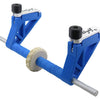
The solution takes a minute: the SVS design lets you swap between the wooden roller and the stainless steel roller without tools. Modularity was a requirement from our very first drawing.
Part of a Complete System
The wooden roller is not a passive block of timber. The frame allows micro-adjustments for slab thickness - no rulers, no wooden guide strips, and guaranteed consistency down the length of your slab. Stainless steel offers sub-millimeter precision that wood cannot match due to natural tolerances, giving you the right tool for every clay body.
Join the Community
Have you tried rolling clay completely canvas-free? What wood treatments do you use in your studio? Share your experience in the comments below. We read every response, and Tomáš and Věra are always around to help you tune your setup.
-
For Studio Artists & Enthusiasts: Check out the full specifications of our SVS Manual Slab Roller and configure the setup that fits your workflow. The wooden roller is also available separately.
-
For Studio Owners, Schools & Instructors: Join the Relyef Studio Partner Program (RSPP) for equipment discounts, student promo codes, and studio referral commissions.
-
For Retailers & Distributors: Interested in stocking our patented SVS Slab Roller? Contact our B2B team for wholesale pricing.
-
Posted in
ceramics, clay, creative, Relyef, Stainless Steel Roller, stamps, Stamps for pottery clay, texture, Wood Roller